
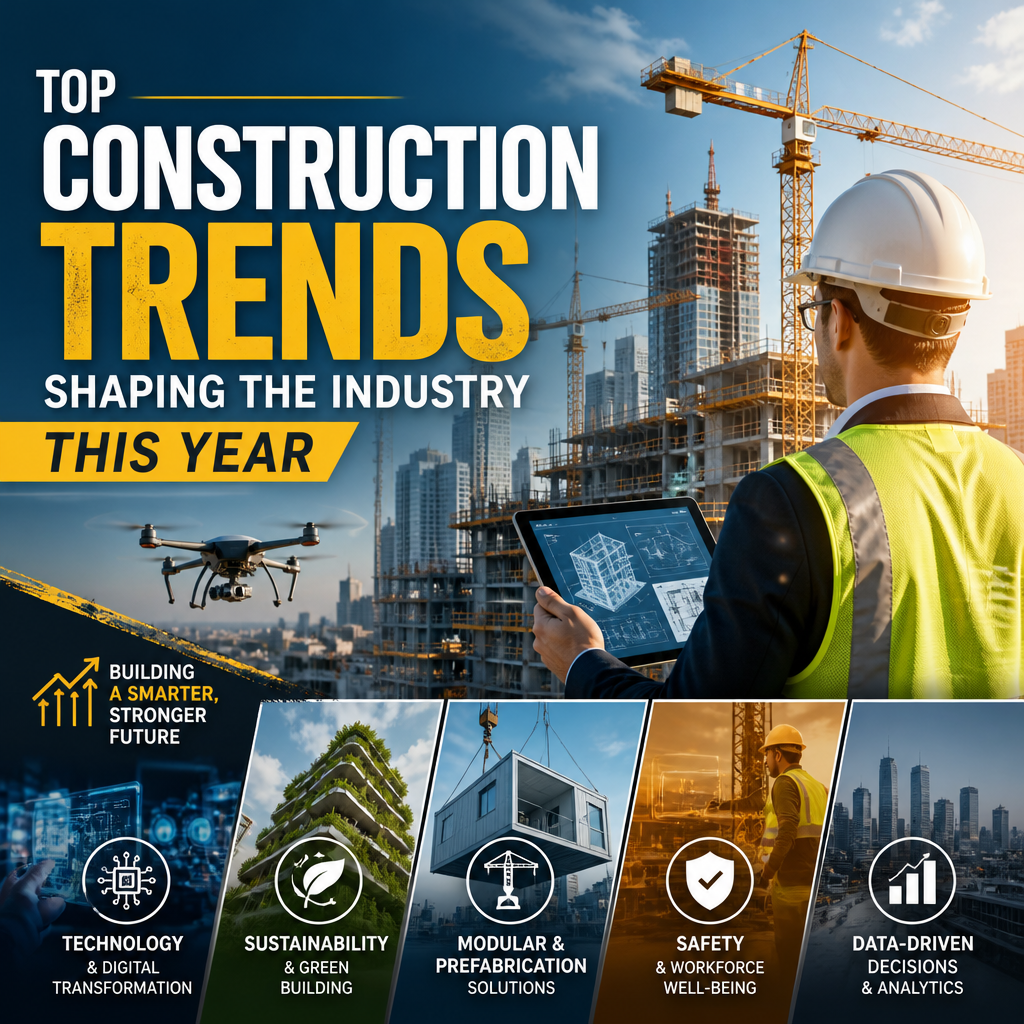
Top Construction Trends Shaping the Industry This Year
Top Construction Trends Shaping the Industry This Year
The construction industry is entering a period of rapid transformation. New technologies, changing client expectations, labor challenges, and environmental priorities are influencing how projects are designed, managed, and completed.
From artificial intelligence to sustainable materials, these construction trends are helping companies improve productivity, reduce costs, and deliver safer, more efficient buildings.
1. Artificial Intelligence and Automation
Artificial intelligence is becoming an important tool across the construction lifecycle. Companies are using AI to analyze project data, identify potential delays, estimate costs, and improve scheduling.
AI-powered platforms can review plans and detect conflicts before construction begins. This helps teams reduce rework and avoid expensive mistakes. Predictive analytics can also identify risks related to weather, supply chains, and labor availability.
Automation is expanding on job sites as well. Robotic equipment can assist with tasks such as bricklaying, surveying, excavation, and concrete finishing. While these technologies are not replacing skilled workers, they are helping crews complete repetitive or physically demanding work more efficiently.
2. Modular and Prefabricated Construction
Modular construction continues to gain momentum because it can shorten project timelines while improving consistency. Building components are manufactured in controlled factory environments and then transported to the job site for assembly.
This approach offers several advantages:
- Faster construction schedules
- Less material waste
- Improved quality control
- Reduced disruption around the job site
- Greater worker safety
Prefabrication is being used for everything from residential units and classrooms to healthcare facilities and commercial buildings. As manufacturers improve their capabilities, modular construction is becoming a practical option for projects of many sizes.
3. Sustainable Building Practices
Environmental responsibility is now a central priority for developers, contractors, and building owners. Sustainable construction involves more than installing energy-efficient systems. It also includes reducing waste, selecting responsible materials, and minimizing a project’s overall carbon footprint.
Popular strategies include using recycled or locally sourced materials, designing for energy efficiency, and incorporating renewable energy systems such as solar panels. Low-carbon concrete, mass timber, recycled steel, and other innovative materials are also receiving increased attention.
Green certifications and stricter environmental standards are encouraging the industry to consider a building’s entire lifecycle, from material production and construction to operation and eventual demolition.
4. Building Information Modeling and Digital Twins
Building Information Modeling, or BIM, remains one of the most valuable digital tools in modern construction. BIM creates a detailed, shared model of a building that can be used by architects, engineers, contractors, and owners.
The model helps project teams coordinate designs, detect clashes, estimate materials, and plan construction sequences. It also improves communication by giving everyone access to a consistent source of project information.
Digital twins take this concept further by creating virtual representations of physical buildings or infrastructure. These models can be updated with real-time data from sensors, allowing owners to monitor performance, schedule maintenance, and improve operational efficiency after construction is complete.
5. Advanced Job Site Safety
Safety technology is evolving alongside other construction trends. Wearable devices, smart helmets, connected cameras, and site sensors are helping companies monitor working conditions and respond to hazards more quickly.
Some systems can detect fatigue, unsafe movements, restricted-area access, or proximity to heavy equipment. Drones are also being used for inspections and progress monitoring, reducing the need for workers to enter dangerous areas.
These tools work best when combined with strong safety training and clear site procedures. Technology can support safer decisions, but a safety-focused culture remains essential.
6. Workforce Development and Skilled Labor
Labor shortages continue to affect construction projects in many regions. In response, companies are investing more heavily in training, apprenticeships, and digital tools that help workers perform their jobs effectively.
Virtual reality simulations can provide hands-on training without exposing new workers to real-world hazards. Digital project management tools also make it easier for teams to communicate, access plans, and track tasks from the field.
Attracting younger workers and promoting construction as a technology-driven career will be increasingly important. The industry needs professionals who understand both traditional building methods and emerging digital systems.
Looking Ahead
The construction industry is becoming more connected, data-driven, and environmentally conscious. Companies that adopt new technologies while continuing to prioritize quality, safety, and workforce development will be better positioned for long-term success.
These construction trends are not isolated changes. Together, they represent a broader shift toward smarter planning, more efficient operations, and buildings designed to meet the demands of a changing world.
